
What -40°C Solar Operation Actually Requires
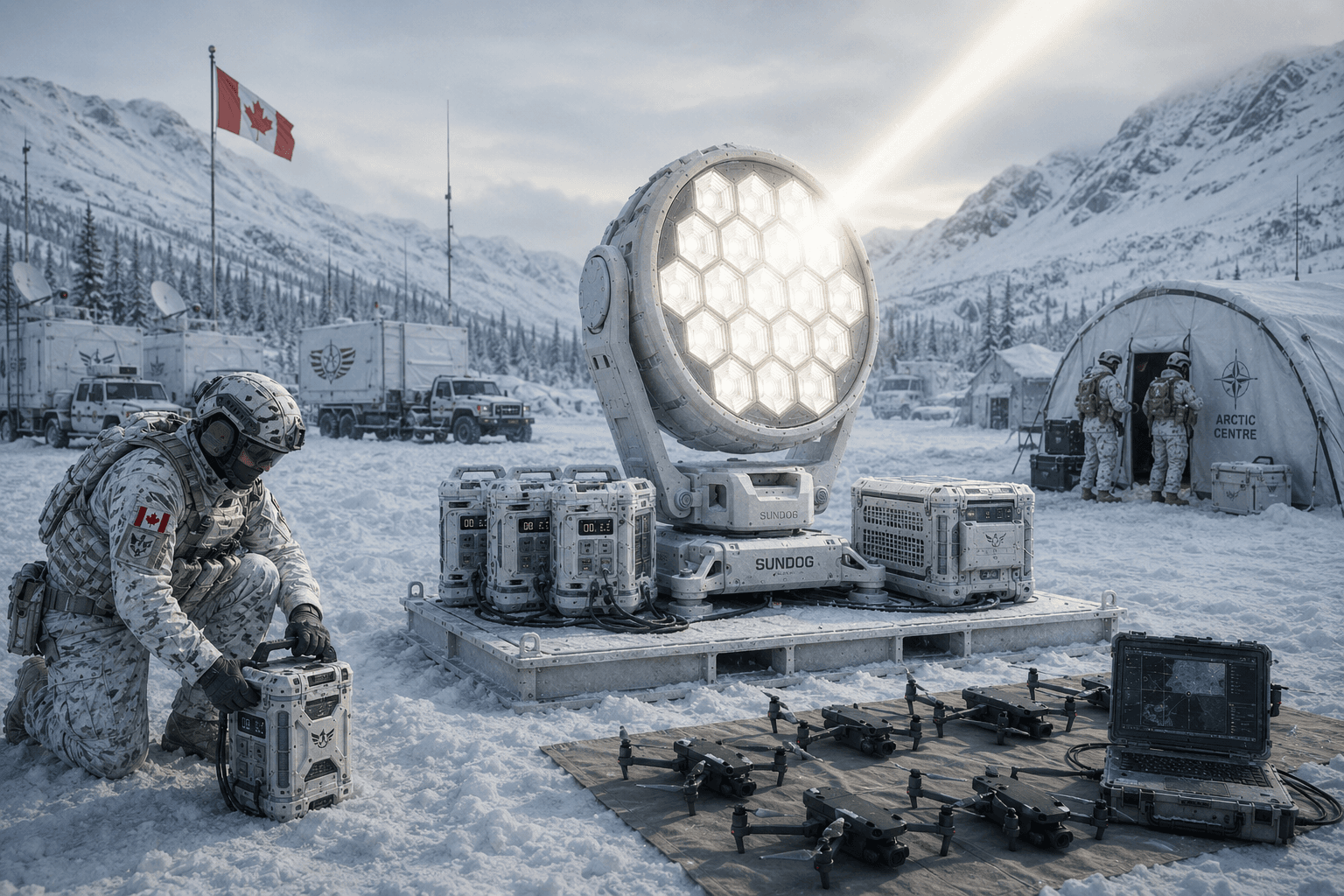
Concept render: SES System (SunDog CPV collector + BESSe modular batteries) deployed in an arctic operational environment.
Most solar vendors publish a minimum operating temperature on their spec sheet. The number is easy to print. The engineering required to actually hit it is harder than most operators assume — and for the sites where it matters most, the answer is not the same one that works in Arizona.
The cold-weather solar problem
Solar deployments in northern Canada, Alaska, Scandinavia, and other high-latitude environments face a different set of failure modes than the temperate-climate installations that drive most product design. Snow loading, thermal cycling, battery chemistry behaviour, and component embrittlement all become first-order design constraints rather than nice-to-haves.
The result is that a system rated for "-20°C operation" — which sounds adequate for most Canadian sites — will routinely fail in the field at northern mining camps, Arctic telecom installations, and forward operating bases above 60° latitude. The failures are rarely catastrophic. They are slow, expensive, and persistent: batteries that refuse to charge in the morning, trackers that bind on cold lubricant, connectors that crack on the second winter, and inverters that throttle output for reasons the data sheet did not warn about.
The PV cells are the easy part
A common misconception is that solar cells perform poorly in the cold. The opposite is true. Silicon photovoltaic cells produce slightly higher open-circuit voltage at low temperatures — roughly 0.3% per degree Celsius below standard test conditions. A clean panel at -30°C in bright sun outperforms the same panel at +25°C.
Multi-junction CPV cells perform even better. The III-V semiconductor materials used in concentrator photovoltaics have lower temperature coefficients than silicon — their efficiency degrades less in heat and remains more stable in cold. A CPV system at -30°C in clear winter sun delivers near-rated performance.
The problem at -40°C is not the cells. The problem is everything else.
The real problem: battery chemistry
Lithium iron phosphate (LiFePO4) — the dominant chemistry for stationary and field-deployable energy storage — has a well-characterised cold-weather problem. Below 0°C, charging acceptance drops sharply. Below -20°C, charging without internal heating causes lithium plating on the anode, which is irreversible and degrades cell capacity permanently. Most well-designed battery management systems will simply refuse to charge a LiFePO4 cell below 0°C without active heating intervention.
Discharge behaviour is more forgiving but still constrained. A LiFePO4 cell at -20°C delivers approximately 70% of its rated capacity. At -30°C, capacity drops below 50%. At -40°C, an unheated cell is effectively unusable.
The implication for a remote solar-plus-battery system is concrete: in winter conditions, the system cannot store solar-generated energy from the morning into the afternoon — or from a sunny day into an overcast one — without active battery heating. A battery system rated to -40°C without an embedded heating subsystem is either overstated or designed around chemistries with a fundamentally different cold-weather profile.
What "rated to -40°C" actually means
For LiFePO4 systems, it means embedded self-heating. Resistive elements inside the battery module activate when cell temperature drops below approximately -20°C, drawing a small amount of stored energy to warm the cells back into their charge-acceptance window. The system trades a few percent of available capacity for the ability to operate in conditions where the alternative is no operation at all.
Why we built a dual-chemistry battery system
LiFePO4 is not the only available chemistry for stationary storage, and in cold climates it is not always the right one. Sodium-ion cells have a fundamentally different cold-weather profile: charging is supported down to approximately -10°C, and discharging extends to -40°C without active heating. The trade-off is slightly lower energy density and a less mature supply base, but for sites where ambient temperatures spend significant time below -20°C, sodium-ion delivers performance that LiFePO4 simply cannot match with passive thermal management.
The BESSe modular battery platform is built around this reality. The pack architecture supports both LiFePO4 and sodium-ion modules on the same physical bus, with chemistry-specific charge profiles managed by the battery management system. Operators can specify the chemistry mix that matches their deployment envelope — LiFePO4 for energy-density-sensitive applications, sodium-ion for extreme cold, or a hybrid configuration that uses each chemistry where it performs best.
This is not a hedge. It is a recognition that cold-climate energy storage is a different engineering problem than temperate-climate storage, and that forcing one chemistry to solve both creates compromises in both directions.
The other half of the problem: materials and mechanics
The component failures that take down solar systems in cold weather are usually unglamorous. Standard PVC-jacketed cable becomes brittle below approximately -25°C and can crack on the second or third winter cycle. Bolted connections lose preload as steel and aluminium contract at different rates. Hydraulic and electromechanical actuators stall on lubricant that has thickened beyond design viscosity. Plastic enclosures lose impact resistance. Sealants and gaskets fail. Connector contacts that handle 20A in summer fail to make reliable contact in winter due to oxide buildup combined with thermal contraction.
Cold-rated solar deployments require explicit component selection across the entire bill of materials: TPE or silicone-jacketed cabling rated to -40°C, stainless fasteners with appropriate thermal-cycling margins, sealed bearings packed with low-temperature grease, polymer enclosures rated for the temperature range, and connectors specified for the actual deployment envelope. None of this is exotic. All of it is more expensive than the warm-climate equivalents.
Snow, ice, and the tracking advantage
Fixed-tilt solar panels at northern latitudes have a snow problem. The optimal fixed-tilt angle at 55°N is approximately 45°, which is shallow enough that snow accumulates rather than shedding. Snow on a fixed array blocks generation and, in cold conditions, can sit on the array for weeks before melt or manual clearing. This compounds the existing problem of low winter sun angle at northern latitudes — fixed panels at high latitude generate a small fraction of their summer output in winter, and snow loss makes it worse.
Sun-tracking systems address both problems. Trackers follow the full solar arc regardless of how low the sun is in the sky, which substantially improves winter generation at high latitudes. They can also be commanded to a steep dump-off angle for snow shedding, or stowed for high-wind conditions. The mechanical complexity is real, but the additional winter generation typically justifies the cost at sites above approximately 50°N.
Concentrator photovoltaic systems also reduce the active cell area substantially — the cell footprint is a small fraction of the equivalent flat-panel array for the same rated output. This means less surface area to keep clear of snow and ice. The lens face requires only a thin transparent path to function, and the steep dump-off angle clears it readily.
Active management: the collector knows when it is in trouble
Passive cold-weather design — sealed enclosures, cold-rated materials, embedded heating — is the foundation. Active management is what separates a system that survives northern winters from one that operates productively through them.
The SunDog collector incorporates an integrated environmental sensing and mitigation stack designed specifically for cold-climate deployment. The system detects icing, snow accumulation, freezing precipitation, and high-wind conditions autonomously, and responds without operator intervention.
When sensors register conditions that threaten the optical surface — accumulated snow, freezing rain, ice formation — the tracker commands the collector into a protective stow position that minimises exposed surface area and accelerates natural clearing. The system holds this defensive posture until conditions allow safe return to tracking. The same sensor stack triggers active ice-clearing on the lens face when it detects ice formation that the protective stow will not shed on its own.
The optical surface itself carries a multi-functional coating that combines anti-reflective, anti-soiling, and anti-icing properties on a single film layer. The coating reduces ice adhesion enough that the active clearing system can remove what does form using methods that would not be appropriate for conventional solar glass. This combination — coating performance plus a clearing approach tuned to the lens material — is a deliberate engineering choice that allows the SunDog collector to maintain operation in conditions that immobilise conventional fixed-tilt installations.
The implementation details of the sensing, stow logic, coating, and ice-clearing mechanism are subject to pending patents and trade-secret protection. Operators evaluating SES for cold-climate deployment can receive a detailed technical briefing under NDA.
Why cold sites have the strongest hybridization economics
The economic case for solar hybridization is strongest at exactly the sites where cold-weather operation is required. Northern mining camps, Arctic and sub-Arctic oil and gas operations, remote telecom installations above the tree line, and forward operating bases in northern theatres all share the same cost profile: high diesel logistics premium, expensive unscheduled maintenance, supply chain exposure during winter resupply windows, and limited road access for emergency intervention.
A fly-in mine camp pays $8.00–$12.00 CAD per litre for delivered diesel including logistics — two to three times the depot rate. Every operating hour displaced by solar is reducing fuel consumption at a much higher real cost than the headline fuel price suggests. The same hybridization system that delivers a four-to-seven month payback at a road-accessible remote site can pay back in as little as three to five months at a fly-in operation, because the cost being displaced is significantly higher per kWh.
The catch is that the system has to actually function in the conditions where the economics are strongest. Solar equipment that fails in its second winter at a fly-in camp is not a useful asset — it is a stranded capital expenditure and a logistics liability. The engineering investment required to genuinely operate at -40°C is the price of admission to the sites that need solar hybridization the most.
Model your site economics
Cold-site fuel premiums dominate the cost equation. Enter your delivered diesel price and the calculator does the rest.
The honest spec
Pulling the threads together: the SES System operates from -40°C to +50°C, with a series of distinct mechanisms handling different parts of the range. Between -20°C and +50°C, the battery operates without active heating. Below -20°C, the embedded self-heating subsystem engages and the system continues to operate at a small parasitic cost in stored energy — or the operator can select sodium-ion modules that extend the unheated operating range further. Above +50°C, separate thermal management maintains cell temperature within design limits.
Cabling, connectors, fasteners, and enclosure materials are specified for the full operating range. The collector and battery enclosures are sealed against condensation, dust, and precipitation. Active environmental monitoring on the SunDog tracker provides the autonomous protective response described above.
The full operating range is -40°C to +50°C, with the qualification that cold operation below -20°C requires the chosen thermal management mechanism — either self-heating on LiFePO4 modules or the broader temperature tolerance of sodium-ion modules — to be functioning correctly. Site-specific cold-climate engineering reviews are available for qualified pilot partners under NDA.
SES is in prototype development, targeting P1 completion in Q3 2026. Cold-climate deployments are a priority for pilot partner selection in 2026.